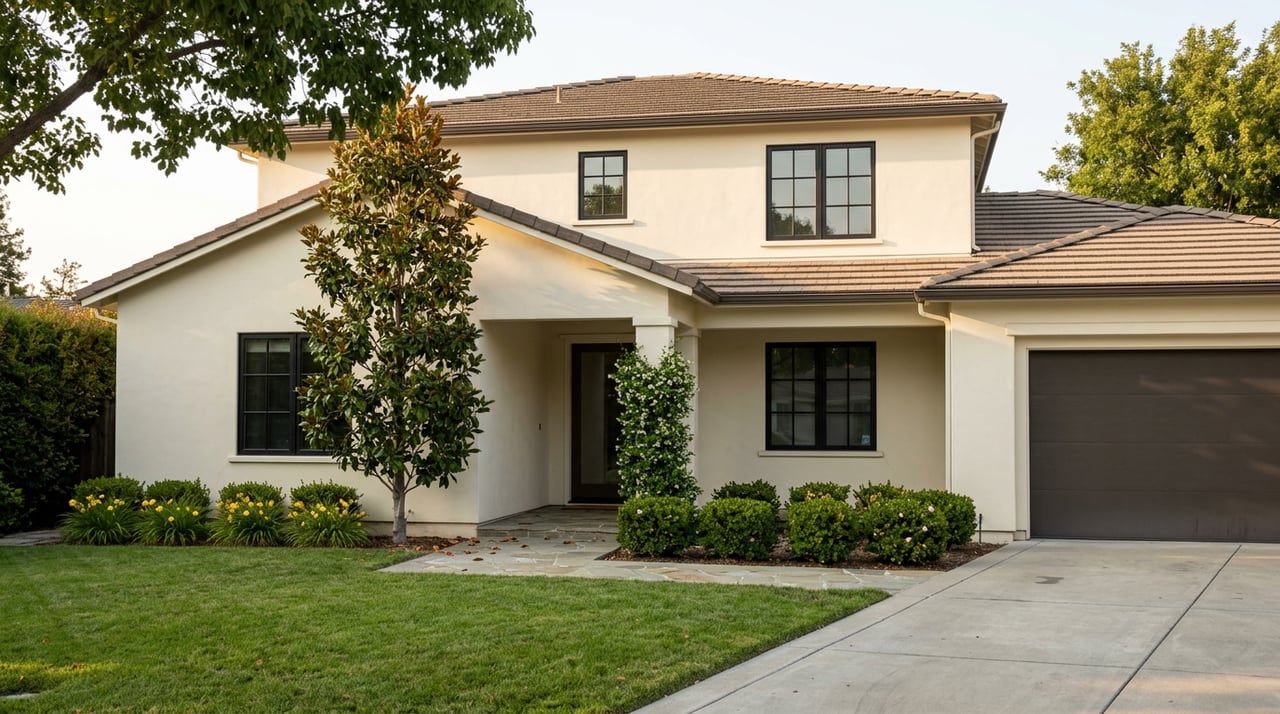
A seller lists a home south of Ventura at $5,395,000. An offer comes in at $5,500,000, clean, no contingencies, and the seller's first instinct is to celebrate. It is the wrong instinct. That offer, accepted as written, leaves the seller with about $115,000 less than the asking price would have.
This is not a rounding quirk. It is the single most consequential piece of transaction friction at the top of the Sherman Oaks market, and it explains a pattern that shows up in the recorded price data across the City of Los Angeles: a wall of sales that stop just short of a specific number, and almost nothing immediately above it.
The tax has a dead zone, and it is about $225,000 wide
Measure ULA is not a bracketed tax. It is what economists call a notch. Cross the threshold by a dollar and the rate applies to the entire recorded price, not to the portion above the line. For transactions closing after June 30, 2026, the City of Los Angeles Office of Finance sets that line at $5,400,000 for the 4 percent tier and $10,900,000 for the 5.5 percent tier. Both thresholds adjust every July 1 by Chained CPI. The rates have never moved.
So a sale at exactly $5,400,000 owes $216,000. A sale at $5,399,999 owes nothing. Which creates a stretch of prices where more is worse.
| Recorded price | ULA tax | Seller keeps |
|---|---|---|
| $5,399,999 | $0 | $5,399,999 |
| $5,450,000 | $218,000 | $5,232,000 |
| $5,600,000 | $224,000 | $5,376,000 |
| $5,625,000 | $225,000 | $5,400,000 |
| $5,750,000 | $230,000 | $5,520,000 |
Figures exclude the base documentary transfer taxes, which run 0.45 percent to the city and 0.11 percent to the county and apply on both sides of the line.
A seller does not get back to even until roughly $5,625,000. Every price between the threshold and that recovery point is a worse outcome than stopping short. The same shape repeats at the upper tier, where moving from 4 percent to 5.5 percent creates a narrower dead band running from $10.9 million to roughly $11.07 million. RAND researchers, writing about the original thresholds, put the mechanic plainly: a property selling for $5 million incurred no ULA tax, and one selling for a dollar more paid $200,000. The dollar figure has grown with inflation. The cliff has not softened.
The practical consequence for a seller in Longridge Estates or on the hillside streets between Kester and Coldwater is that the pricing decision is no longer continuous. There is a price, and then there is a gap, and then there is a different price. A buyer's agent who offers $5,475,000 on a $5,395,000 listing is not being aggressive. They are, unintentionally, asking the seller to pay for the privilege of a stronger headline number.
The comps at the top of this market are partly an artifact
Here is the part that changes how you should read a comparative market analysis in this price band.
Researchers at the UCLA Lewis Center examined the distribution of recorded sale prices in the City of Los Angeles before and after the tax took effect. Before, prices showed the modest round-number clustering you would expect, small spikes every $500,000. After, the pattern changed profoundly, with a large spike appearing immediately below the threshold. A peer-reviewed analysis published in the Journal of Public Economics reached the same finding and added a second one that matters more: the drop in transaction volume above the line is persistent, not a temporary retiming effect that reverses once the market adjusts.
The magnitude is not subtle. Michael Manville of UCLA and Mott Smith of USC, analyzing roughly 338,000 Los Angeles County sales from 2020 through 2024 and comparing city transactions against surrounding cities not subject to the tax, found the odds of a sale exceeding the threshold fell by about half.
Read that alongside the city's own collection figures. As of April 30, 2026, the tax had raised close to $1.2 billion from 1,633 transactions, according to the Los Angeles Housing Department. Fewer than two thousand qualifying sales in just over three years, across every property type, across the entire City of Los Angeles.
Now bring it back to one neighborhood. An independent sales tracker counted 308 Sherman Oaks closings over the six months ending in August 2026, with a median around $1.39 million. As of August 20, 2026, the median list price sat near $2.26 million against 154 active listings. The homes that reach the ULA band here are a thin top slice, mostly larger properties south of the boulevard and new construction. When that band produces only a handful of closings a year and a meaningful share of them were priced to stop short of a tax line, the comp set you are pricing against is not a clean signal of value. It is a signal of value plus avoidance behavior, and the two are difficult to separate without knowing which sales were engineered.
The other half of the response is that people stopped selling
The cheapest way to avoid a $216,000 line item is to not transact at all. That shows up in the Valley as construction activity rather than listing activity.
The Real Deal reported in July 2026 that remodel permits for high-end homes have risen 46 percent since the mansion tax took effect. One development firm described its mix flipping from roughly 80 percent new construction and 20 percent remodels before the tax to about 60 percent remodeling and 40 percent new builds after, with the renovations growing more ambitious, sometimes stripped to the studs with a single wall left standing.
"It has become part of nearly every meaningful conversation we have about timing, pricing, renovation and whether a sale makes financial sense."
That is Emil Hartoonian of The Agency, who works Sherman Oaks and Studio City, in the same reporting. He also said the tax has created real hesitation among owners weighing a sale.
For a buyer, this is worth understanding as inventory context rather than as a policy complaint. Fewer owners at the top of Sherman Oaks are choosing to move. More of them are pouring capital into the house they already own. That thins the field of available large homes and simultaneously raises the finish level of the ones that eventually do come to market.
The wait-for-repeal strategy is finished
Plenty of seller-facing content published earlier this year still tells owners that a statewide repeal is coming in November. That advice is now stale, and acting on it would cost a year.
- In June 2026, the Howard Jarvis Taxpayers Association withdrew its transfer tax initiative as part of a legislative deal. CalMatters reported that the resulting compromise does not touch real estate transfer taxes.
- The replacement on the November 3 ballot is Proposition 43, which would raise the approval threshold for future citizen-initiated local special taxes to two-thirds beginning January 1, 2027. It applies prospectively only. Taxes already approved are not at risk.
- Local reform also stalled. The City Council shelved a ballot measure that would have exempted newly built apartments, after the Housing Department estimated it would trim ULA revenue about 5 percent while adding roughly 330 units a year. LAist quoted Councilmember Katy Yaroslavsky warning her colleagues that the pressure for reform will not go away.
- The one ULA item voters will see is narrow. On August 4, 2026, the Council voted 13-1 to place a one-time, five-year exemption for homes damaged or destroyed by the January 2025 Palisades Fire on the November ballot. It does nothing for a Valley seller.
The only threshold movement anyone in Sherman Oaks can count on is the annual CPI adjustment, which lifted the line from $5.3 million to $5.4 million this July. Roughly $100,000 a year. If your home would trade within a hair of the current line, waiting for the next adjustment is a legitimate strategy. If it would trade at $6.2 million, waiting is just a year of carrying costs and market risk.
What this actually changes about pricing and negotiation
Three things, in order of how often they get missed.
Compare offers net, not gross. At this tier every offer should be evaluated after the tax, not before it. A buyer offering above the line with a ULA credit is economically equivalent to a materially lower clean price, and the two look nothing alike on a summary sheet.
Decide which side of the line you are on before launch, not during escrow. The tax attaches to gross recorded price, not to gain. Your basis, your improvements and your mortgage payoff do not reduce it. A home that could plausibly appraise anywhere from $5.2 million to $5.9 million needs a pricing decision made deliberately, because the middle of that range is the worst place to land.
Read your comps for engineering. When you see a recent sale at $5,350,000, ask whether that was the market clearing or a seller declining to cross a line. In a band this thin, one misread comp moves your entire strategy. Timing matters here too, and it interacts with the seasonal rhythm of this market more than most sellers expect.
None of this is tax or legal advice, and thresholds reset every July 1. Confirm the current figures with your escrow officer and your CPA before you commit to a list price.
If your home sits anywhere near the line, the modeling should happen months before the photographer does. We build seller net sheets against actual Sherman Oaks closings at both tiers, not against a generic estimate, and we will tell you honestly when the answer is to hold. Start with a valuation, or look at what is currently available in Sherman Oaks if you are on the buying side. The Kumar Group works this band closely, and the difference between a good outcome and an expensive one is usually decided before the sign goes up. Let's Connect.
FAQ
Does the tax apply to the whole price or only the amount above the threshold? The whole recorded price. A sale at $6,000,000 owes 4 percent of $6,000,000, regardless of what the owner paid or what is still owed on the property.
Does Sherman Oaks fall under Measure ULA? Yes. Sherman Oaks sits entirely within the City of Los Angeles. Independent cities in the region operate under their own transfer tax rules, which is one reason a buyer weighing Sherman Oaks against a market outside city limits is comparing two different eventual exit costs.
Can the buyer pay it? A contract can allocate it, but in practice sellers pay it in this market. Buyers at this price point have alternatives and rarely absorb it. Pricing strategy is where the real planning happens.
Is there a primary residence exemption? No. There is no exemption based on occupancy, age, or whether the sale produced a gain. The tax is on the transfer, not the profit.